Building-to-building links
Explore point-to-point wireless where cabling is difficult or impractical. We review the route, mounting locations and the capacity your operation needs.
 Let’s talk ↗
A cable is not always the practical answer. We help connect buildings, outdoor areas and complex sites with wireless approaches chosen around distance, access and the environment.
Talk about your project ↗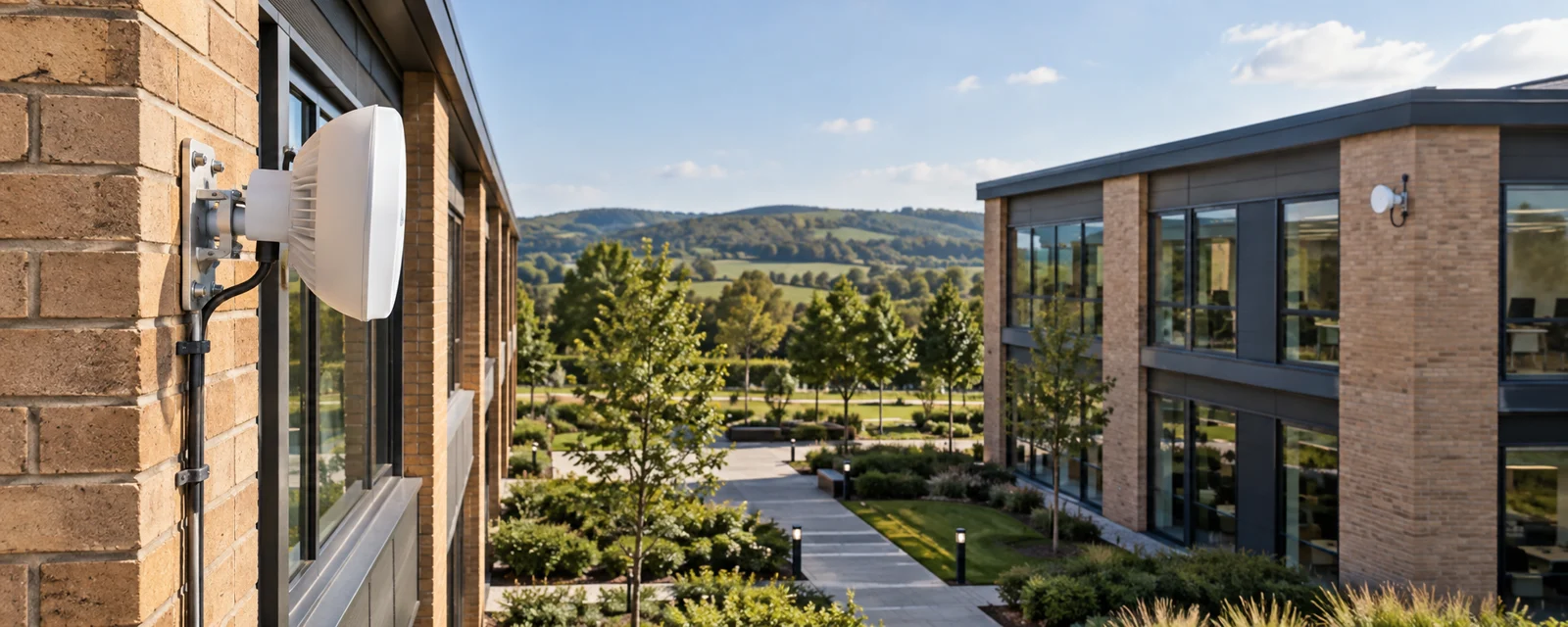 Illustrative installation environment, not a specific client site or vendor model.
A considered approach, with the right scope for your environment.
Explore point-to-point wireless where cabling is difficult or impractical. We review the route, mounting locations and the capacity your operation needs.
Plan access for open spaces and venues around where users gather, the applications they use and suitable mounting locations.
Distance, obstacles, line of sight and power all shape a wireless solution. We assess these constraints before recommending an approach.
Plan how the new connection joins your existing infrastructure, including addressing, switching and network separation where required.
Guest accommodation, offices, event spaces and outdoor areas are not always in the main hotel building. Where a cable route is difficult, a building-to-building wireless link may be an option. We assess the route, distance, obstacles, mounting positions and capacity before choosing a design.
Outdoor hotel Wi-Fi needs its own coverage and capacity plan for terraces, courtyards and places where guests gather. Equipment choice, power, cabling and weather exposure all matter. We also consider how the link or access points join the wider hotel network, including guest separation and management access. Trees and obstructions are assessed during planning; feasibility needs a site review.
Explore hotel IT solutions ↗Tell us what you have today, where it falls short and what you need next. We’ll help turn that into a practical plan.
Let’s discuss your setup ↗Obstructions can significantly affect a link. Feasibility depends on the route and technology; we need to assess the path rather than promise performance without a survey.
The building locations, approximate distance, available mounting points, power and required capacity provide a useful starting point.